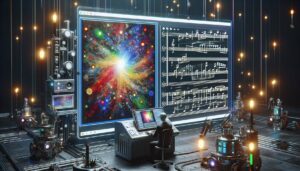
Hey tech adventurers! Grab a cup of coffee, settle into your cozy chair, and let’s talk about Artificial Intelligence in the creative arts. What gets me excited about this topic is how it brings together logic and artistry in this weird, fascinating way. We’re talking about robots that paint, algorithms that compose symphonies, and machines that write novels. I mean, who saw that coming?
Keep reading as I break down this world of AI-powered creativity. By the end, you might find yourself genuinely curious about what a robot artist could create.
AI’s Artistic Awakening
A Dash of History
Let’s rewind a few decades. The early forms of machine creativity were amusing but pretty basic, to be honest. I remember first reading about Harold Cohen’s AARON, a program that painted abstract art back in the 1970s when computers took up entire rooms! Fast forward to today, and AI isn’t just experimenting with art anymore. It’s producing works so good they’ve been auctioned at Christie’s and Sotheby’s. That Christie’s auction where an AI-generated portrait titled “Edmond de Belamy” sold for $432,500? That proved we’re way past pixelated stick figures.
The Tech Behind the Magic
Okay, let’s get a little technical here. At the heart of AI-generated art are neural networks, specifically something called Generative Adversarial Networks (GANs). Without getting too nerdy about it, GANs have two networks: a generator that creates images, and a discriminator that judges them. They basically compete against each other until the art gets refined and improved. It’s like a creative battle royale.
The Palette of Possibilities
Painting and Visual Art
Artists like Mario Klingemann are using neural networks to push the boundaries of visual art. These AIs can study the styles of famous painters and produce new works that make us question what “art” actually means. Imagine AI-generated pieces that feel like Monet but aren’t quite Monet. It’s something to think about on a rainy afternoon.
AI in Music
Look, I love my vintage vinyl collection as much as anyone, but AI is shaking things up in music. Take OpenAI’s MuseNet and Google’s Magenta. These programs compose melodies across different genres and instruments, even ones they’ve never been specifically trained on! The goal isn’t to replace your favorite singer-songwriter, but to expand what’s possible in musical creativity.
Literature and Content Creation
If you’re a writer, you might be feeling a bit nervous right now. Yes, AI tools like GPT-3 have written poems and short stories. But let’s be clear: these digital writers aren’t about to replace Shakespeare or Maya Angelou anytime soon. What they are is a useful tool when you’re stuck with writer’s block. Think of AI as a writing assistant, editor, or co-author that can help your creative process along. Plus, it won’t argue with you about plot twists.
Challenges and Considerations
Authenticity and Value
Here’s the big question: Is AI-created art actually authentic? As one artist put it, “Isn’t all art a form of imitation and originality at once?” Whether we should value AI creations the same way we value human-made art leads to some pretty heated dinner table debates. It’s one of those existential questions that makes art so interesting. Who knew robots would get us thinking philosophically?
Ethical Musings
It’s not all sunshine and roses though. Imagine an AI that learns Picasso’s style and starts producing “Picassos” by the dozen. That creates some serious ethical problems. We’re dealing with questions about intellectual property, originality, and copyright laws. Should an AI’s creation belong to the developer, the AI itself, or no one at all? The law is still trying to catch up with the technology, which makes this whole thing even more complicated.
A Glimpse of the Future
What might the next few decades look like with AI and art working together? My guess is AI will push us to rethink what art fundamentally is. Artists might start using AI as a creative partner rather than seeing it as competition. We might see entirely new art forms that we can’t even imagine yet. Maybe pieces that learn and change throughout our lifetimes. Sound crazy? So did painting robots and composing algorithms just a few years ago.
Alright, tech explorers, that’s our journey through AI in the creative arts. If I’ve accomplished anything today, I hope it’s showing you how much potential this field has. So put on your creative thinking cap, because we might be heading toward a world where machines and paintbrushes, processors and pianos actually work together. Until next time, keep exploring the weird and wonderful world of technology.
