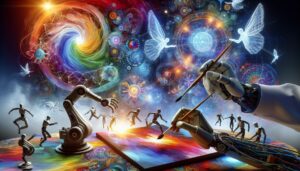
Hey, fellow tech enthusiasts! Have you ever stopped to think about just how much creativity is changing right before our eyes? We’re watching a huge shift happen, and it has geeks like me buzzing with excitement while artists stare at their palettes in awe or mild terror. It’s the AI revolution in the creative arts, and boy, is it a game-changer. Now, I’m not saying that robots are about to snatch up all our paintbrushes and DJ booths, but they’re definitely joining the party.
The Rise of AI Artists
I’m sure you’ve heard about AI creating art, music, and writing, right? But let me tell you, these aren’t just simple doodles or robotic beeps anymore. AI is creating real masterpieces, and it’s doing it in ways that blow my mind. Take OpenAI’s DALL-E, that incredible piece of tech. It can generate artwork based on text descriptions with crazy good detail and style. I watched it create an “astronaut riding a horse in a futuristic city” piece, and folks, it looked like something straight out of a sci-fi movie.
Now, before you start thinking this spells doom for human artists, hold up. What’s really cool is that artists are grabbing this technology like a new paintbrush. Instead of feeling replaced, many artists feel energized. They’re working with AI, guiding the creative process in wild new directions. It’s like Picasso had a little robot helper in his studio, ready to throw fresh ideas at cubism.
Algorithms in A-Minor: AI Comes to Music
Hands up if your playlists can’t keep up with your weird taste in music? Enter AI-powered music generators. These amazing systems, like Jukedeck (now part of TikTok) and Amper Music, are writing entire symphonies at the click of a button. Music used to be pure human expression, something only we could do. Now we have algorithms creating whole new genres, mood-shifting tunes, and personalized soundtracks for our daily lives.
Let me share something that happened to me. A few months back, I was working on a project and hit a massive creative wall. I found an AI music generator, fed it some moods and ideas, and boom! Fresh music tracks that got my brain working again. It was like having a virtual Beethoven compose custom symphonies just for me.
But here’s the really interesting part. AI isn’t just playing robot DJ or composer. It’s true collaboration. Musicians are jamming with algorithms, mixing raw human feeling with computer smarts, letting us explore sounds we never imagined. Think of it as a jazz session where your sax player is half genius, half silicon chip.
A Novel Approach: AI in Literature and Storytelling
Let’s talk about writing, where AI is cranking out stories across every genre and emotion you can think of. I remember testing a neural-network writing program, and honestly, its prose got to me. Maybe it just made me spill my coffee in shock, but either way, AI is becoming quite the digital Hemingway.
OpenAI’s GPT series has been huge in this space. From creating dialogue and poetry to building complex stories, these neural networks can copy human writing styles with scary accuracy. On one hand, it’s a great tool for generating ideas and getting past writer’s block. On the other hand, it’s a frighteningly good copy of creativity that even experienced writers find unsettling.
Here’s where things get really exciting. Writers can beat the dreaded blank page using AI for inspiration. AI might suggest a plot twist or help develop a character that would’ve stayed boring otherwise. It’s like having a brainstorming partner who’s read everything and never gets tired.
The Challenges and Ethical Quandaries
Of course, it’s not all perfect. With this tech paradise comes problems that get louder every day in online discussions. Ownership, copyright, and authenticity top the list of questions that need serious answers. Who owns an AI-created artwork? Is it the person who programmed the AI, or the machine itself? And how real is creativity when it comes from something that isn’t human?
Then there’s the question of soul. Sure, AI-generated music might sound great today, but can it replace human emotion and the beautiful messiness of human art? I’m not convinced. There’s something special about a handwritten poem or a homemade track that no machine can touch.
The New Co-Pilots of Creativity
While AI in creative work remains controversial, one thing’s clear: the line between technology and human creativity is blurrier than ever. Rather than killing traditional art, AI in creative fields is adding new layers and possibilities, a fresh dimension to work with.
My take? These AI systems aren’t replacing artists. They’re becoming the ultimate creative partners. Think Bob Ross and his happy little robot trees. We’re seeing the start of something new, promising tons of diverse art forms and endless possibilities. We can’t wait to see how this plays out, and like many others, I’m watching with wide eyes and excitement. Looking ahead, the tools and sounds of tomorrow are just getting started.
So, what do you think? Let’s mix some pixels with that paint and keep creating with both technology and human imagination. I think it’ll be amazing to watch, and I’m here with my popcorn ready for every single digital brushstroke.
