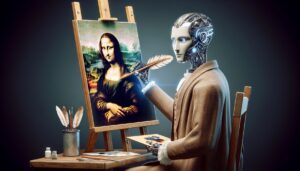
Hey, fellow tech enthusiasts! Today we’re diving into a fascinating universe where creativity, innovation, and artificial intelligence collide. AI in creative arts—it’s like giving the brush to a robot and watching it paint a Mona Lisa! Okay, maybe not quite yet, but we’re getting closer. Let’s explore how AI is reshaping the creative arts scene, turning traditional art forms on their heads, and what it could mean for the future.
The Digital Canvas: How AI is Changing Art Creation
When you think of art, you probably imagine an artist hunched over a canvas, paintbrush in hand. These days, though, many artists are armed with keyboards and machine learning algorithms. Artificial intelligence in art has come a long way from being a mere assistant. Now, it’s a full-fledged creator.
One of the early AI artists was DeepDream, an algorithm from Google that quickly went viral for its trippy, hallucinogenic images. It was fascinating yet strange, like if Salvador Dalí had let a thousand butterflies loose in his studio. But what started as a curiosity has become an essential tool in the modern artist’s toolkit.
Machine learning models like GANs (Generative Adversarial Networks) have taken this a step further. They can create new and unique artworks by learning the details of styles ranging from Renaissance to modern abstract. Artists can now collaborate with AI, using it to generate ideas and push the boundaries of their creativity. Case in point: the now-famous AI-generated painting by Edmond de Belamy, which sold at Christie’s for over $432,000! That’s when the world really started to take notice.
Democratizing Creativity: Art for Everyone
One of the most exciting aspects of AI in arts is its democratizing power. Not everyone has the skills of a professional artist. But with AI tools, anyone can experiment with creativity, regardless of their background or expertise.
Apps like Artbreeder and DeepArt allow users to create beautiful visuals without needing extensive training or equipment. Imagine making your own masterpiece while sipping coffee at your kitchen table. These AI tools take the intimidation out of art and invite everyone to the creative party.
However, for those same reasons, it brings up a critical question: Is creativity still purely human if AI is doing the heavy lifting? It’s a philosophical question that’s sparking debates across art circles. Purists may argue it cheapens art, but I think it’s more of a gateway to wider participation. After all, the brush doesn’t make the artist—it’s the vision behind the brushstrokes.
Bridges and Barriers: The Challenges Ahead
With great power comes great challenges. While AI unlocks new potential, it also introduces complex issues, like authorship. Who owns an AI-created piece of art—the machine, the programmer, or the person inputting data? This question could stump even Solomon, and it’s just one of the many legal and ethical dilemmas we’ll need to address.
Moreover, there’s a concern that AI might contribute to making art feel like just another commodity, lowering the appreciation for human-originated works. But much like the advent of photography didn’t erase painting, AI is unlikely to replace human artists. Instead, it may elevate their roles, providing artists with unprecedented ways to express their visions. In this new world, humans and machines are collaborators rather than competitors.
The Long Game: Future Prospects and Speculations
Imagine a world where AI isn’t just a tool but a creative partner capable of understanding and even influencing human emotions. Futuristic? Absolutely, but it’s not outside the realm of possibility. As AI systems become more sophisticated, we might see AIs that can produce original, emotionally resonant art or even contribute to writing the next great novel or screenplay.
Tech giants like OpenAI and Google already invest vast resources into making AI more creative. The advancement in natural language processing, like with OpenAI’s GPT series, shows the potential for AI to co-create engaging narratives, dialogue, and plots.
Could we see an AI-generated movie sweeping the Oscars in our lifetime? Maybe. As speculative as it sounds, remember that just a few decades ago, the concept of AI making a painting seemed as far-fetched as flying cars.
My Take: Art in the Age of AI
Personally, I find the marriage of AI and art exhilarating. It’s a little bit thrilling and a whole lot fascinating to witness this evolution. Sure, there are growing pains and ethical hurdles ahead, but progress is seldom a smooth ride.
AI won’t rob us of our humanity or artistic identity. Instead, it could open doors to creativity we’ve yet to imagine. So, if you haven’t already, give it a whirl. Whether you’re sketching or just daydreaming about it, remember: in the age of AI, the sky’s not the limit—it’s just the beginning.
What’s your take on AI in the arts? Is it the next Sistine Chapel, or are we getting ahead of ourselves? Let me know your thoughts. Until next time, keep questioning, keep innovating, and, most importantly, keep creating. Cheers!

Comments