The Vanishing Act of Literary Circles
You know that moment when you’re reading a biography of your favorite author and suddenly encounter a name that stops you cold? Someone who was apparently their closest friend, their fiercest rival, their most trusted reader—and you’ve never heard of them. It happened to me last month while reading about Virginia Woolf’s circle. There was Vita Sackville-West, of course, and Lytton Strachey, but also this woman named Violet Dickinson who was Woolf’s intimate correspondent for decades. Dickinson wrote too, published novels that were well-reviewed in their time. Yet she’s become literary archaeology, buried under the weight of her more famous friend’s reputation.
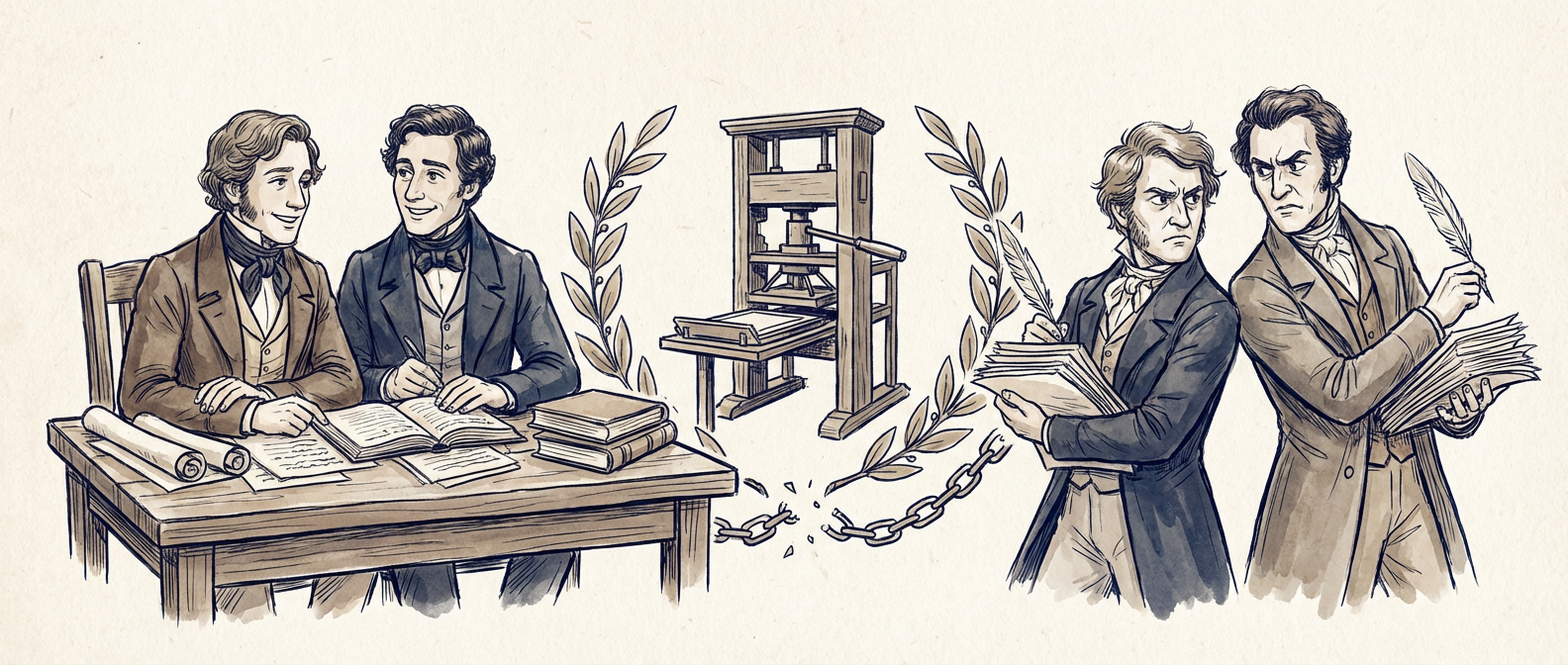
This isn’t just about forgotten writers. It’s about how literary history gets written and rewritten, how certain voices rise while others sink into what I call “deserved obscurity.” But was it really deserved? Or is obscurity just what happens when you’re standing too close to a supernova?
Literary friendships and rivalries create their own ecosystem, one where talent, timing, and sheer luck determine who gets remembered. The survivors write the stories, and sometimes those stories are incomplete. We lose individual voices, yes, but also entire conversations. The call and response that shaped the literature we still celebrate today.

The Darwin Effect in Action
Take the case of Ernest Hemingway and his Paris years. We know about his friendship with F. Scott Fitzgerald, partly because both men became literary legends, and partly because Hemingway wrote about it in “A Moveable Feast.” But what about Harold Loeb, the real-life inspiration for Robert Cohn in “The Sun Also Rises”? Loeb was a novelist himself, founder of the literary magazine Broom, and a significant figure in the expatriate literary scene. His novel “Doodab” got critical acclaim. Yet he’s remembered primarily as Hemingway’s punching bag, the character everyone in the novel despises.
Loeb wrote his own memoir, “The Way It Was,” attempting to set the record straight about his relationship with Hemingway and the events that inspired the novel. It’s a fascinating document that reveals how literary friendship can curdle into something toxic when one friend’s star rises faster than the other’s. But Loeb’s version of events remains a footnote to Hemingway’s mythology. The winner writes history. Hemingway won.
This pattern repeats throughout literary history. For every famous writer, there’s often a shadow figure, a friend who encouraged, challenged, or competed with them, who helped shape their work but didn’t receive equal recognition. These relationships weren’t just social. They were creative laboratories where ideas were tested, refined, and sometimes stolen.
When Rivalry Breeds Excellence
Sometimes the forgotten figure actually pushed the famous one to greatness. Consider Mary McCarthy and Elizabeth Hardwick. Both were formidable critics and novelists, both central figures in New York’s intellectual scene in the 1950s and 60s. But McCarthy is the one most people remember today, perhaps because her novels had more bite, or because her affairs and feuds were more public. Hardwick, meanwhile, co-founded The New York Review of Books and wrote some of the most incisive literary criticism of her generation.
Their relationship was complicated. Part friendship, part professional rivalry. Reading their correspondence and the memoirs of their contemporaries, you get the sense that they made each other better writers through their competition. Hardwick’s sharp intelligence kept McCarthy honest. McCarthy’s willingness to be disliked freed Hardwick to be more direct in her criticism. Yet Hardwick’s reputation has faded while McCarthy’s has stuck around, even though Hardwick’s institution, the NYRB, continues to shape literary culture today.
This makes me wonder how many other creative partnerships we’ve misunderstood or forgotten entirely. How many “solo” geniuses were actually part of a dialogue we can no longer hear because only one voice survived?
The Archaeology of Influence
Digging into these forgotten relationships reveals something important about how literature actually gets made. It’s rarely the solitary genius myth we love to tell ourselves. More often, it’s messy and collaborative, involving multiple minds and personalities. The letters between writers, their memoirs, and the accounts of people who knew them paint a picture of literature as fundamentally social.
When Jean Rhys’s reputation was revived in the 1960s, decades after her early novels had been forgotten, scholars discovered her correspondence with Ford Madox Ford, who had mentored her in Paris in the 1920s. Ford was already a significant literary figure, but their relationship illuminated aspects of both writers’ work that had been invisible. Rhys’s portrayal of damaged women wasn’t just personal. It was part of a broader conversation about modernity and alienation that she’d been having with Ford and others in their circle.
Unearthing these relationships doesn’t just rescue forgotten writers from obscurity. It changes how we read the famous ones. Hemingway’s machismo looks different when you understand it partly as a performance for his literary circle. Woolf’s innovations seem less isolated when you see them in conversation with the experimental work her friends were attempting.
What We Lose in the Winnowing
The cost of literary forgetting isn’t just sentimental. When we lose half of a conversation, we misunderstand the other half. We create false mythologies about individual genius and miss the collaborative nature of literary innovation. We also lose diversity. The forgotten figures are often women, people of color, or writers from working-class backgrounds whose voices didn’t fit the literary establishment’s preferred narrative.
But here’s what keeps me reading these literary biographies and memoirs at midnight, texting friends about discoveries: every forgotten writer is a door back into their era’s literary conversations. Reading Harold Loeb’s memoir alongside “The Sun Also Rises” doesn’t diminish Hemingway. It makes both writers and their world richer and stranger. Finding out about Violet Dickinson’s novels doesn’t challenge Virginia Woolf’s genius. It reveals the intellectual community that nurtured it.
The “deserved obscurity” test, the assumption that history naturally sorts the wheat from the chaff, fails to account for all the factors beyond literary merit that determine who gets remembered. Timing, gender, class, connections, and pure chance all play roles in literary survival. Sometimes the most interesting discoveries happen when we dig up the supposedly minor figures and find they weren’t minor at all. Just unlucky.
So next time you’re reading about your favorite author’s life, pay attention to those names that appear and disappear. Look them up. Some of them wrote books that might surprise you, books that illuminate corners of literary history we thought we knew. The conversations that shaped the literature we love are still there, waiting to be overheard again.
